Written by: Gillian Fraser
God’s creation is full of beautiful and amazing creatures. The latest species to be discovered, according to a report by National Geographic, is a new species of pygmy seahorse, the Hippocampus Nalu, also known as the African Pygmy Seahorse. This discovery occurred in South Africa, and is the first of its kind on our continent (and in the Indian Ocean). The seahorse is reportedly the size of a grain of rice.
The researcher behind this monumental discovery is Dr Richard Smith, a scientist from the UK. Dr Smith and a team of fellow South African researchers recently published their findings in the ZooKeys zoology journal.
It is a first of its kind to be found anywhere in the Indian Ocean or the African continent. According to Dr Smith, “it’s like finding a kangaroo in Norway.”
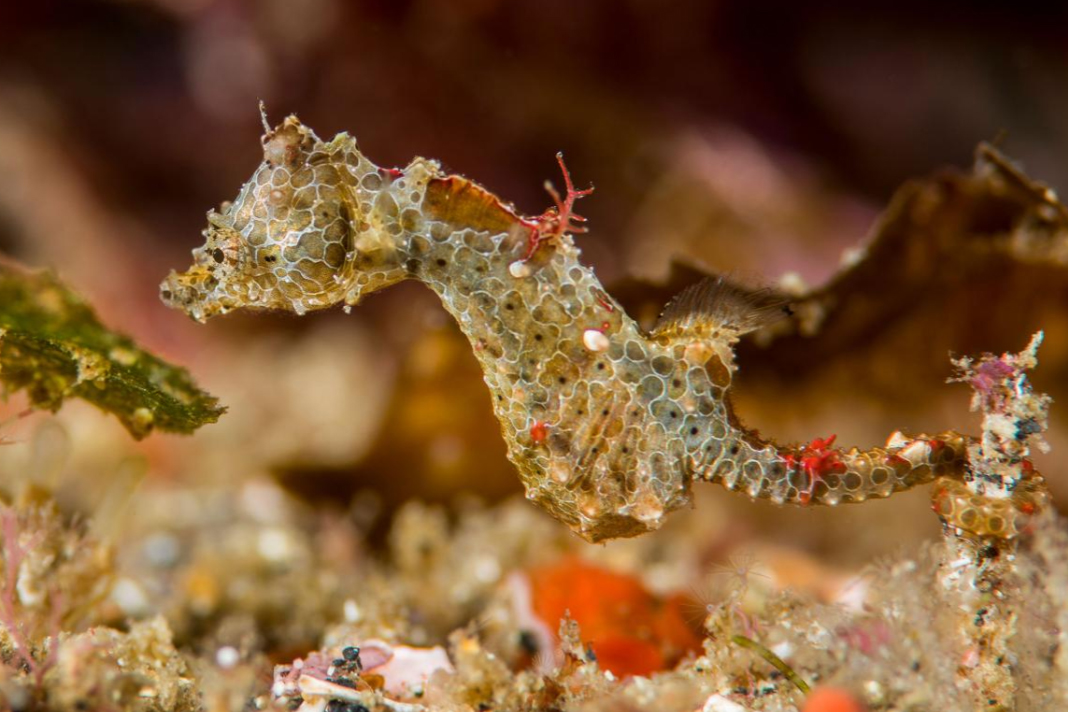
This newly described species of pygmy seahorse (Hippocampus japapigu) blends into the algae-covered rocks where it lives in Japan. Photograph By Richard Smith
It was a shock to the team to find a pygmy seahorse so far from the Coral Triangle. The Coral Triangle is a roughly triangular area of the tropical marine waters of Indonesia, Malaysia, Papua New Guinea, Philippines, Solomon Islands, and Timor-Leste.
There is one species that has also been found in Japan waters. The original finding was made by dive instructor Savannah Nalu Olivier in Sodwana Bay in 2017. After the finding, research began, and this led to its official discovery. Savannah was honoured by having the species named after her.
Hippocampus nalu is currently known only from shallow (12–17 meters depth) waters in Sodwana Bay, South Africa, which falls within the iSimangaliso Wetland Park, a World Heritage Site that stretches from Lake St Lucia in the south to the Mozambique border in the north, and along the north coast of KwaZulu Natal province.
However, the new species likely has a wider distribution along the East African coast and remains undetected because of its cryptic behaviour and diminutive size, and therefore its occurrence further north off East Africa in Mozambique, Tanzania, and Kenya, and offshore to Madagascar, may be confirmed by future localised ichthyofaunal surveys.
Click here to KEEP UPDATED on the latest news by subscribing to our FREE weekly newsletter.
Date published: 31/05/2020
Feature image: Hippocampus nalu, also known as the African pygmy seahorse, is about the size of a rice grain, and was found living well camouflaged among algae and sand in Sodwana Bay, South Africa. Photograph By Richard Smith
DISCLAIMER
JOY! News is a Christian news portal that shares pre-published articles by writers around the world. Each article is sourced and linked to the origin, and each article is credited with the author’s name. Although we do publish many articles that have been written in-house by JOY! journalists, we do not exclusively create our own content. Any views or opinions presented on this website are solely those of the author and do not necessarily represent those of the company.