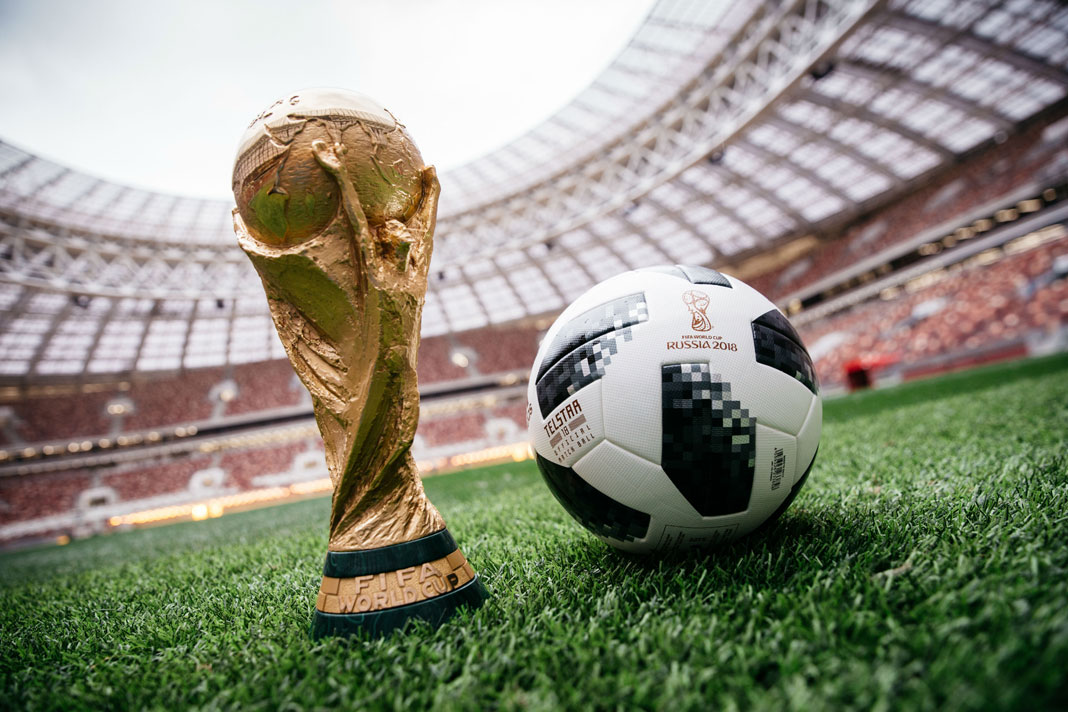
With the daily news saturated with reports of wars, acts of violence and scenes of hatred, the FIFA World Cup™ offers a brief opportunity for people to shift their attention to the soccer fields of Russia for a ‘war’ of a different kind.
The FIFA World Cup™ is the single biggestsporting event in the world and is contested by the senior men’s national teams from the 208 Member Associations of FIFA. The competition has been played every four years since the inaugural tournament in 1930, except in 1942 and 1946 when it was not held because of the Second World War.
FIFA’s objectives are “To touch the world, develop the game, and build a better future through a variety of ways.” The current format of the tournament involves 32 teams competing for the title at venues within the host nation(s), over a period of one month – this phase is often called the ‘Final Competition’. A qualification phase, the ‘Preliminary Competition’, which currently takes place over the preceding three years, is used to determine which teams qualify for the tournament, together with the host nation(s).
The 2018 FIFA World Cup™ in Russia is the 21st edition of the “biggest sport event on the planet”, and the first to be held in Eastern Europe. Of the 32 teams, 20 will be making back-to-back appearances following the last tournament in 2014, including defending champions Germany, while Iceland and Panama will both be making their first appearances at a FIFA World Cup™. A total of 64 matches will be played in 12 venues located in 11 cities. It kicked off on 14 June and culminates with the final in Moscow on 15 July.
Like everything in life, there are some valuable lessons, both good and bad, to learn from events like these, especially when it comes to those ‘battling on the pavilions’ – the spectators.
Here are FIVE.
1. SACRIFICE
THE GOOD
It is amazing to see to what lengths fans will go to in order to support their teams. FIFA, the International Association of Football Associations, expects a cumulative audience of the 64 matchesto be in excess of 26 billion fans. Every single spectator, whether paying for a ticket or watching on TV, will in one way or another make a conscious decision to sacrifice money, time and/or effort to watch the tournament.
The most affordable tickets for group stage games will sell for $105 (R1,380). The most expensive “category one” tickets for the final match retail at $1,100 (R14,500). It is true that what we hold precious will only be revealed by what we are willing to pay for it.
As Christians, we need to ask ourselves how much we are willing to sacrifice for the sake of the Gospel. Jackie Pullinger said: “The principle of the Gospel is this, ‘The Gospel always brings life to the receiver, and death to the giver.’ If the Gospel brought death to Jesus Christ, why do we think that in preaching the Gospel it would be any different to us?”
According to Scripture, one of the first duties of every believer is to count the cost – not to count the blessings or promises, as we so often emphasise during our altar calls, but to count the cost. Luke 14:28 clearly instructs us to count the cost, indicating that Christianity is not for the faint-hearted: “’If one of you is planning to build a tower,’ Jesus said, ‘you sit down first and figure out what it will cost, to see if you have enough money to finish the job.’” Then come these words in verse 33: “In the same way, any of you who does not give up everything he has cannot be My disciple.”
THE BAD
Sadly, people often sacrifice at the expense of others for their own pleasure and fulfilment. People will save for years, at the expense of family and loved ones, to attend a match. This sacrifice is often for a short-lived and self-enriching experience that could have benefitted others over a longer term. As Christians, we need to be careful not to sacrifice spiritually for short-lived experiences when we have the opportunity to invest in the Kingdom for eternal rewards. For example, going to Christian conference after Christian conference is not wrong, but there comes a time when our sacrifice needs to translate into a benefit for others.
2. HOPE
THE GOOD
There is always the wonderful hope that no matter how low your team may be ranked, or how good the opposition may be, victory might still be achieved. Think back to 1950 – in one of the biggest upsets in World Cup history, the American team, led by a team of semi-professionals and only having a 9.5% chance of winning, pulled off a 1-0 victory against tournament-favourite England, in front of a crowd of over 10,000 in Belo Horizonte, Brazil. It would take Team USA 44 years and a tournament held on home soil to win a World Cup match again, a 2-1 victory over Colombia.
A more recent upset was Switzerland’s 1-0 win (in 2010) over eventual tournament winners Spain. The Swiss had only a 10.3% chance of winning the match over the tournament favourites and succeeded despite shooting only six shots on goal compared to Spain’s 22.
There is always hope. According to Romans 8:24-251, hope stresses two things: (a) futurity and (b) invisibility. It deals with things we cannot see or have not received, or both. How wonderful to know that what seems to be evident in four weeks of football can be evident in life as well. As Christians, we should always stress the ‘futurity’ in Christ and the sureness of grace in the midst of the ‘invisibility’ thereof. Our hope is not based on a wishy-washy kind of unsure optimism that maybe, just maybe, things will go our way eternally, but on a blessed assurance that the victory has already been obtained.
THE BAD
We should guard our hearts against basing our hope on circumstances and people. What if it rains? What if Messi and Ronaldo played for Spain instead? What if a key player gets hurt?
What if we had a Christian president? What if our economy was better? We, as Christians,should also guard our hearts against basing our hope on our political leaders or on the security of our possessions. We have hope because of Christ and we need to be ‘conveyor belts’ of that hope.
3. INCLUSIVITY
THE GOOD
Referred to as “the beautiful game”, soccer (or football) is played by hundreds of millions of people and watched by billions of fans each year. Soccer brings different fans and cultures together and can even unite enemies, as witnessed in the Ivory Coast when the national soccer team helped warring parties reach a truce.
Sport, and especially a tournament of this nature, has a way of uniting people who
would normally see themselves as opposition at the very least. Race, religion, culture
and background matters little when your team scores a goal and you are on the
winning side.
Supporters of the Azzuri, as the Italian team is known, are a good example. Despite
Italy being characterised by a variety of influences (from Arabic on the island of Sicily
to the Austro-Hungarian empire in South Tyrol) and being a country where Catholics
and Protestants often clash, all differences are set aside when it comes to the Azzuri.
Come the World Cup, out comes the firecrackers,the costumes and the flares. In 2006,
an estimated 200,000 watched Italy win the World Cup in Rome, then celebrated
together throughout the city.
As Christians, we should always find harmony in what binds us together instead of
seeking theological differences that divide us. Like Paul, we need to resolve “To know nothing except Jesus, and Him crucified” (1 Corinthians 2:2). If we believe that, then we are family in Christ, regardless of what ‘team we shout for’ and our doctrinal differences.
THE BAD
The ‘bad’ happens when things do not go according to plan, and scapegoats are identified to ease the pain of losing.
As quickly as sport unites, it can also divide. Fans often follow their teams with such passion that soccer is not only a sport, but a ‘religion’. Extreme supporters, known as ultras, are some of the most fanatical fans and often resort to hateful chants and fighting when it comes to supporting their clubs. Over the past decades, this fanaticism has translated into numerous cases of fighting, reported stabbings and damage to restaurants, pubs and shops associated with rival fans.
As Christians, we need to seek a spirit of reconciliation in the good times as well as when things do not go according to plan. When political leaders make decisions that could potentially harm us, we need to display Christian virtues more than ever.
4. LOYALTY
THE GOOD
Loyalty is a fast-disappearing virtue in the world, but events like the World Cup seem to create a wonderful sense of unity among like-minded supporters. Those who criticise their leaders, their fellow-countrymen, their political parties and even their national heroes throughout the year suddenly become loyal citizens willing to fight for (or make fools of themselves for) their “beloved” country. Loyalty comes with a sense of pride that seems to be ignited when people unite for a singular purpose.
Loyal fans often personify the nations they represent. Loyal hooligans can disgust other fans, just as respectful fans can endear a nation to others. The Japanese crowd is a good example: they will always applaud a good move regardless of whether it’s by their own team or the opposition. They extend their love for their team beyond their team’s reach.
As Christians, our loyalty to Christ will be reflected in how we stand up for the values that He reflected on earth: grace, love, forgiveness, unity, charity, etc. We need to draw people in by the way we stay loyal to Christ, and not push people away by our loyalty to convictions. Christians should always be seen as loving, humble and forgiving people, not as judgemental, angry and ‘anti-people’.
THE BAD
Loyalty runs the risk of only being displayed when we are winning and being abandoned when our team is losing. This is seen among ‘bandwagon fans’ and is generally frowned upon by true fans. This is true all over the world. We need to be careful not to become ‘bandwagon Christians’ – being loyal to Christ when it suits us, but abandoning the One who embraced us (while we were still sinners) when we face other Christians’ failures or ‘our team not winning’.
5. HUMILITY
THE GOOD
Soccer, as all sports, has made famous some amazing human beings who recognised their skills only in the context of a bigger picture.
Pele, one of the greatest and most beloved soccer players of all time, was born in conditions of extreme poverty in Sao Paulo, Brazil. The crime-ridden neighbourhood’s despair and hardship allowed Pele to grow a rugged inner force that gave him a strong edge over his competition. Encyclopedia.com says the following: “Pele acquired several nicknames during his career: ‘Gasoline’ for his energy, ‘The Executioner’ for his brilliant ability to finish an offensive drive and put the ball in the net, and, most popularly, ‘The Black Pearl’, because he was precious. On the field, his joy at playing the game he loved was obvious and infectious. Pele would salute the crowd after scoring a goal and, on many occasions, the goalkeeper he had just beaten would wave or bow to him. If a keeper stopped his shot, Pele would often shake hands with him. When he scored, thousands of fans would stand and chant his name.”
The first soccer player to become a millionaire, Pele was overwhelmed with offers to make personal appearances and sign business deals, but he refused to endorse cigarettes or liquor. “I know that I have influence on youngsters and I don’t feel that I want them to think if I should endorse these products I want them to use them,” he said.
THE BAD
There is only one thing worse than a bad loser and that’s a bad winner. Too often, Christians are seen as judgemental because they proclaim the ‘truth’ and claim the ‘only true religion’. In Matthew 22:35-40, a teacher of the Law tried to trap Jesus with a question about the greatest commandment in the Law. “Jesus answered, ‘Love the Lord your God with all your heart, with all your soul, and with all your mind’. This is the greatest and the most important commandment. The second most important commandment is like it: ‘Love your neighbour as you love yourself.’ The whole Law of Moses and the teachings of the prophets depend on these two commandments.”
Richard Rohr says the following in reference to this Scripture: “The only sign of an authentic conversion is love for God and love for neighbour. Not running around with a banner that we have the only true religion, but love.”
May the next four weeks inspire people to unite their hearts, and in doing so, to become more tolerant, more peaceful and more hopeful. May we be reminded that we are all in a race, and that (according to 1 Timothy 6:12, GNB) we need to “Run [our] best in the race of faith, and win eternal life for [ourselves]; for it was to this life that God called [us] when [we] firmly professed [our] faith before many witnesses.”
SOURCES
www.cntraveler.com,www.theguardian.com, www.cbsnews.com, www.fifa.com, www.therichest.com
Article source: www.incontextinternational.or