Written by: Gavin Cox
Article source: creation.com
Archaeologists have discovered a small stone plaque, broken into ten fragments, with intriguing abstract marks in the British Channel Islands. The stone plaques (made of locally sourced microgranite) come from an archaeological site at Les Varines, St Saviours in Jersey, just 28 km from northern France. Researchers interpreted the marks as depicting mammoths, bison, a horse, and possibly a human face.
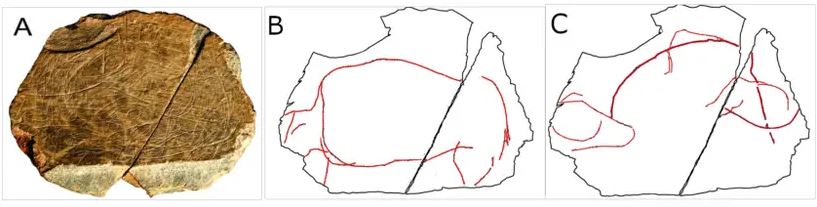
Stone engravings (A), interpreted to show: a bovid (ox/bison) (B); a mammoth and a horse (C) (Credit: After Bello, SM et al. figure 9, ref. 1).
… how could mammoths, bison and horses have been seen thousands of years after the land on which they lived was submerged? Obviously, the dates are wrong. The eye-witness testimony on stone is consistent with that fact.
Using the uranium-thorium dating method they conventionally dated the plaques to the Upper Palaeolithic, supposedly 20,400-8,400 years BP. However, these dates far exceed the Bible’s history, so must be disregarded. Explanations for these and other reports of inflated archaeological ‘ages’ are explained in detail in my article How old? When archaeology conflicts with the Bible.
The ten plaque fragments represent “new evidence” for art from human ancestors.
The artefacts were brought to the surface by a plough in a farmer’s field. However, the stone surfaces are apparently in a “good state of preservation”, which suggests they are younger than supposed.
Similar engraved plaques have been unearthed in Portugal, Spain, France, southern Germany and Belgium. These are attributed to early hunter-gatherers called the Magdalenians, who supposedly flourished between 23,000 and 14,000 years ago.
According to the new study, the Jersey artwork represents the only evidence for the life-styles of the people who colonised the southern half of the Channel Valley after the glacial maximum.
Ice-Age flooding
The best explanation for these interesting new finds is that descendants of those travelling from Babel (c. 2000 BC) settled in the English Channel, before the end of the Ice Age.
Jersey is a small island, just 9 miles (14 km) wide, so is obviously too small to support herds of mammoths, bison and horses. These must have been seen in the generations before the land was later covered by the ocean. During the one Ice Age which followed in the centuries after Noah’s Flood, sea-levels are believed to have been 80–100m lower than today. That means the English Channel and the southern part of the North Sea were actually habitable land. Many mammoth bones have been recovered which demonstrate this fact. The Channel is now thought to have been carved catastrophically in months. Chalk at the Dover strait (joining England to France) was broken through, according to New Scientist, 200,000–450,000 years ago, by an overflowing dam behind the chalk ridge (Weald-Artois ridge).
But how could mammoths, bison and horses have been seen thousands of years after the land on which they lived was submerged? Obviously, the dates are wrong. The eye-witness testimony on stone is consistent with that fact.
Conclusion
The best explanation for these interesting new finds is that descendants of those travelling from Babel (c. 2000 BC) settled in the English Channel, before the end of the Ice Age. They witnessed the animals living in the area, and recorded them on rock. After this, Britain was separated catastrophically from the European mainland when the Ice Age ended. The animal doodles demonstrate the artists were capable of abstract thought. They are not nearly of the same quality or artisanship as some other ancient artwork, notably, animal drawings found in the Lascaux and Chauvet caves in France. However, they are still clearly the work of people, created intelligent and resourceful from the beginning, because they were made in the image of God.

Click here to KEEP UPDATED on the latest news by subscribing to our FREE weekly newsletter.
Date published: 16/11/2020
DISCLAIMER
JOY! News is a Christian news portal that shares pre-published articles by writers around the world. Each article is sourced and linked to the origin, and each article is credited with the author’s name. Although we do publish many articles that have been written in-house by JOY! journalists, we do not exclusively create our own content. Any views or opinions presented on this website are solely those of the author and do not necessarily represent those of the company.