Written by: Tsivya Fox-Dobuler
Article source: unitedwithisrael.org
Nine families from Ethiopia immigrated to Israel on Tuesday.
Israel celebrated the arrival of nine families from Ethiopia Tuesday. They received a royal welcome from Likud party members, who helped streamline the complicated bureaucratic process.
“It’s amazing that Israel continues to bring long lost Jews to the country,” said Aaron Katsof, Head of Development for the Binyamin Regional Council.
Katsof oversees an the Heart of Israel organization, which assists Ethiopians, and spoke with United with Israel (UWI) on the day the Ethiopians arrived.

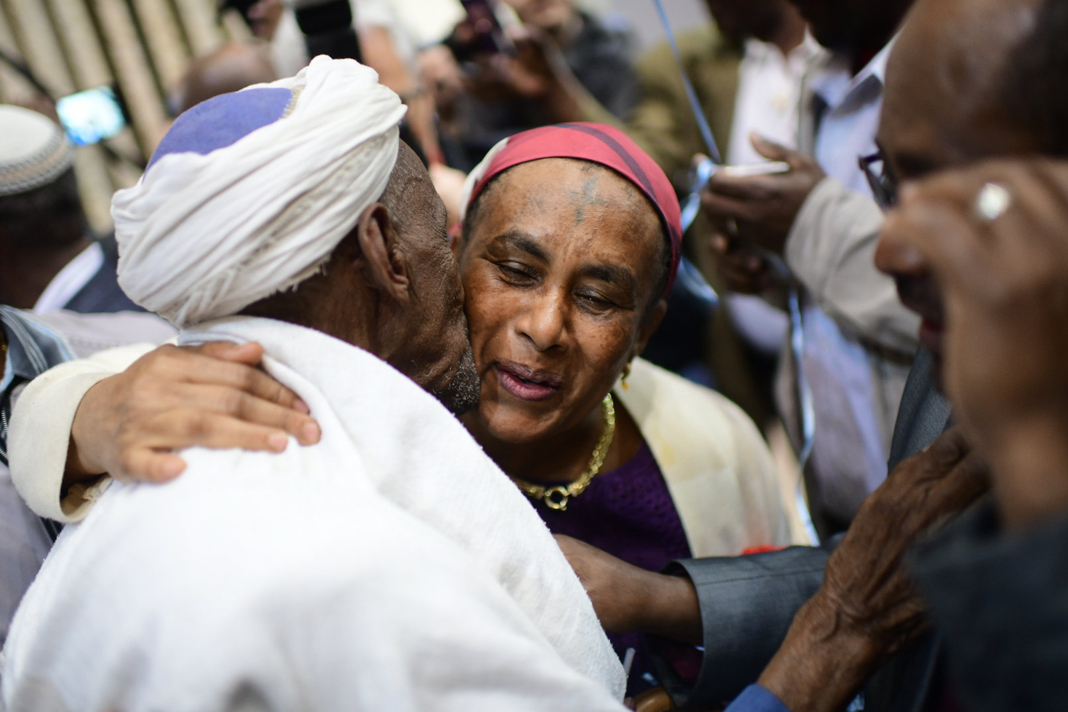
Minister of Immigration and Integration Yoav Gallant greets members of the Falash Mura community upon arrival at the immigration offices at Ben Gurion Airport, near Tel Aviv, on February 4, 2019. (Tomer Neuberg / Flash90)
“Israel not only pays for their flights but gives them free housing in absorption centers, sometimes for years, as well as food, education, Hebrew language skills, courses in Judaism, training in order that they may get decent jobs, and more. I don’t know any other country that does that,” said Katsof.
In 2015, the Israeli government agreed to bring the remaining Falash Mura in Ethiopia to Israel. Since the first airlift in 1984, called Operation Moses, Israel has become home to about 140,000 Ethiopian Jews.
The first arrivals from the Beta Israel community were fully recognized as Jewish. The status of Falash Mura is more complicated because they stem from Jews who were forced to convert to Christianity generations ago.
“Christians gave the Falash Mura their name. It is a nickname for ‘Jew,’” explained Katsof. “The Christians look at them as Jews and Jews historically look at them as not Jewish. However, for over 100 years there has been zero intermarriage in the Falash Mura.”
“There are a lot of hardships,” Katsof said with regard to Ethiopians’ immigration experience in Israel. “They come from villages without running water, toilets or electricity. Their lifestyle is very laid back. Adjusting to the fast pace of Western society is difficult. They need to learn about paying rent and taxes and how to keep a bank account.”
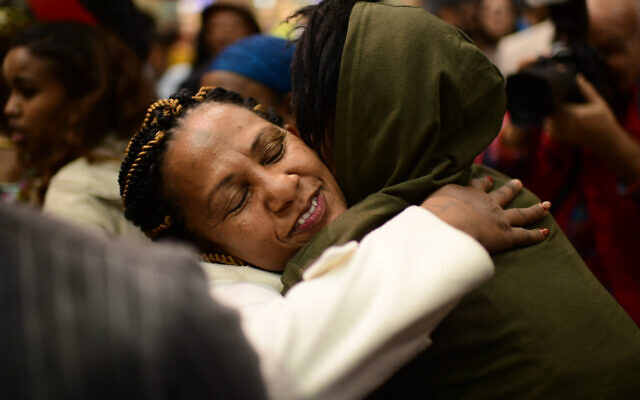
Illustration: Members of the Falash Mura community reunite with their families at Ben Gurion Airport, near Tel Aviv, on February 4, 2019. (Tomer Neuberg / Flash90)
Though there are suspicions that the sudden rush to bring over these 43 new immigrants was politically motivated, Katsof said that “the urgency to help these people is not [politically motivated].”
“The fact that the Likud members suddenly woke up and did this now shows that public opinion wants the Falash Mura where they belong, back home in Israel,” he said.

Katsof concluded, “Every day I speak with people in Ethiopia waiting for their turn to come to Israel. People look back at Jews who were stuck in Russia, Syria, Iran, Morocco and say, ‘If I had been there, I would have helped them get out.’ Now is another time in history when people can help bring Jews home to Israel. Everyone should care about this.”
There are presently about 8,000 Falash Mura with close relatives in Israel still waiting to immigrate.
Click here to KEEP UPDATED on the latest news by subscribing to our FREE weekly newsletter.
Date published: 02/03/2020
Feature image: Members of the Falash Mura community reunite with their families at Ben Gurion Airport, near Tel Aviv, on February 4, 2019. (Tomer Neuberg / Flash90)
DISCLAIMER
JOY! News is a Christian news portal that shares pre-published articles by writers around the world. Each article is sourced and linked to the origin, and each article is credited with the author’s name. Although we do publish many articles that have been written in-house by JOY! journalists, we do not exclusively create our own content. Any views or opinions presented on this website are solely those of the author and do not necessarily represent those of the company.