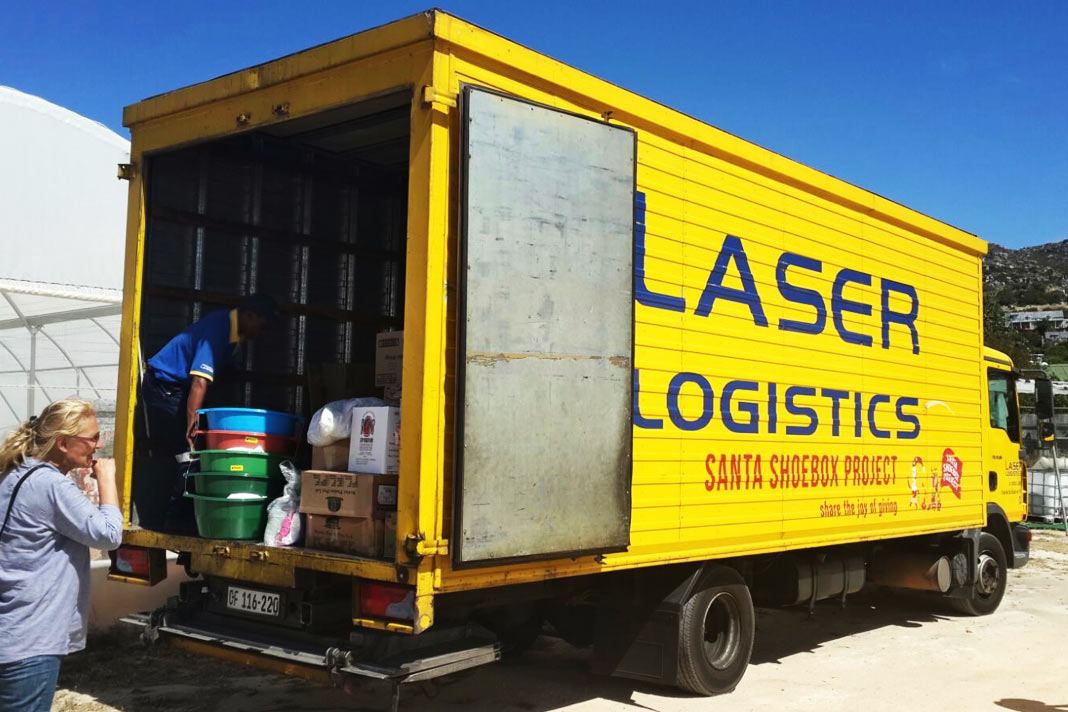
In November 2015 a raging fire destroyed over 1000 homes in Masiphumelela, in the Cape Town area, leaving approximately 1035 families destitute and without shelter. Less than two weeks later, 1035 individually packaged household replacement kits were distributed to these families. “These packs were put in large buckets and included basic toiletries, cooking and eating equipment, and an emergency food package given by the Church across Cape Town in a God-honouring act of care,” says Craig Stewart of The Warehouse in Cape Town. “Some of the volunteers even went as far as ensuring that the face cloths and toothbrushes that went into each parcel were of different colours. The Good News in action!”
The Church helps in times of need
Each summer, Cape Town is vulnerable to fires that destroy thousands of homes in a very short space of time. Whilst disasters can happen in any community, it is the poorest communities in Cape Town that are most vulnerable and who have the lowest capacity to deal with their impacts. Disasters are distinguished from long-term poverty in that they are sudden or progressive incidents that cause death, injury, or damage – and are beyond the capacity of the local community to deal with them. Over the past six years the church in Cape Town has become increasingly present in these moments.
The Church often needs assistance
The Warehouse Trust, established by the Parish of St John’s in Wynberg in 2003, works to support the Church in responding effectively to poverty, injustice, and division. Although there is almost universal agreement that the Church is uniquely positioned to transform society, this belief has not consistently translated into reality in a post-Apartheid South Africa. The Church has shown a willingness to respond to these situations but a lack of capacity, collaboration, and strategic integration has often hindered its effectiveness.
Disaster relief
In 2012, The Warehouse, working with Cape Town’s Consultation of Christian Churches, helped catalyse the establishment of a working group on disaster response and mitigation to increase the effectiveness of the collaborative response of churches in Cape Town and surrounds to large scale disaster incidents. Over the following years, a functional coalition of specialist ministries, churches, and networks began to develop. The coalition initially responded to a few large scale incidents in Cape Town, notably fires affecting the Joe Slovo and Kayamandi communities in 2012 and early 2013, and these helped the coalition define the role of RESPOND in the city.
The benefits of working together
Stewart, who is one of the RESPOND catalysts, says, “Our role is clear now. We co-ordinate a collaborative church response to incidents that affect more than 500 people in the City, we improve collaborative responses to smaller incidents, and we help churches build capacity within themselves to do these well. And we can see the benefits of this combined effort in practical ways.”
Helping where most needed
A good example is the one mentioned above. In the early hours of Sunday, 29th November 2015, a massive fire broke out in the informal settlement of Masiphumele near Fish Hoek. Over one thousand homes, affecting in the region of 4000 people, were destroyed. By 10 am that morning, RESPOND had activated its members in a co-ordinated response.
“Working with MercyNet, the City of Cape Town’s official NGO partner for this disaster and a key RESPOND partner, we were able to ascertain that significant support was being received from local partners on the ground,” says Stewart, “and it was agreed that the best use of RESPOND’s resources would be to target a specific set of items that would be needed by each family following the loss of their homes.”
Treating victims with dignity
During the first week of December, individuals and local churches responded to this call generously, offering the requested items, financial support, and time. On Monday, 7th December, 1035 individually collated household packs were delivered to Masiphumelele, ensuring that affected families got what was needed, when they needed it and in a manner that reflected their dignity as people created in the image of God.
Communication is essential
“This story reflects some key lessons that the coalition has learnt since its inception,” says Craig, “When a disaster happens, good clear communication channels should be established and trusted.” It is key that the response focuses on getting the right stuff, in the right amount and time, to the right people, in a manner that affirms their identity as people created in the image of God and that recognises the deep trauma of the circumstances they find themselves in. “When old, dirty clothes that are seasonally incorrect are donated in black garbage bags it preaches a gospel that is not reflective of the Good News of Jesus in our lives,” explains Craig.
Follow the Bible’s instructions
The prophet Isaiah exhorts us to share our food with the hungry, to clothe the naked, and to provide shelter to the homeless. RESPOND coalition is an expression of this in the Church of Cape Town. Tremendous damage can be done if this is not done in conjunction with initiatives that address long-term transformation in the community and that advocate for the transformation of unjust structures that are the reasons poor communities are vulnerable to these disasters. This can be done with excellence and in ways that affirm the Good News of the Kingdom of God, if held together with the adjacent exhortations to loose the chains of injustice, to untie the cords of the yoke, and to set the oppressed free.
Do you want to get involved?
The RESPOND coalition will be hosting a Churches and Disasters conference in May, along with the publication of a resource manual by The Warehouse. Please contact respond@warehouse.org.za for more information. Visit www.warehouse.org.za for more information about this wonderful ministry.
Written by: The Warehouse Trust
Article source: www.warehouse.org.za