Written by: Ilse Strauss
Article source: www.bridgesforpeace.com
In the two years since the Abraham Accords were inked, warmish ties between Israel and Oman caused rife speculation that the Sultanate might be next to follow in the footsteps of Bahrain, Morocco, Sudan and the United Arab Emirates (UAE) to join the circle of peace with the Jewish state. Yet all hopes of a reconciliation were dashed last week when the parliament passed a vote to criminalize any relations, ties or interactions with “the Zionist entity,” the Jewish Telegraphic Agency (JTA) reported.
Although details pertaining to the ruling remain sparse, the law appears to be all-encompassing. It includes “severing any economic, sports or cultural relations and prohibiting dealing in any way or means, whether it was a real meeting, an electronic meeting or something else,” Oman’s WAF news agency, quoted in JTA, reported Yaqoub Al-Harithi, vice president of the Omani parliament, as saying.
In other words, the decree prohibits all contact with any Israeli by all means, whether in person or online. What this boils down to is that an Omani having coffee with an Israeli anywhere in the world or befriending or adding an Israeli on social media now constitutes a crime punishable by law.
The decision comes as a bit of an about-face. In the years leading up the Abraham Accords, Israel’s relationship with Oman was considered less frosty than with its neighbors. Although the Sultanate adhered to a Royal Decree that banned all “interaction with the Zionist entity for private and public figures,” Oman has never faced Israel on the battlefield and Muscat and Jerusalem even established unofficial trade relations in the early 2000s, JTA explains.
Moreover, between 1994 and 2018, the former ruler Sultan Qaboos Bin Said even invited three Israeli prime ministers to his country, with Yitzhak Rabin’s trip in the early 1990s making history of the first Israeli prime minister to visit a Gulf nation.
With all the factors pointing in a pro-Israel direction, why the turnaround? In a word: Iran.
According to JTA, Qaboos’s death in 2020 marked a shift in foreign policy, with newly appointed Sultan Haitham Bin Tariq choosing to favor cozying up to Tehran instead of Jerusalem.
Does this mark the end of Arab nations normalizing ties with Israel? Hopefully not. With Oman out of the running, Indonesia, Mauritania and Saudi Arabia have been mentioned as potential future peace partners. Yet as unfolding events have frequently proven, in the Middle East, anything is possible and tides—and sentiments—can change as swiftly as the shifting desert sands.
Click here to KEEP UPDATED on the latest news by subscribing to our FREE weekly newsletter.
Date published: 18/01/2023
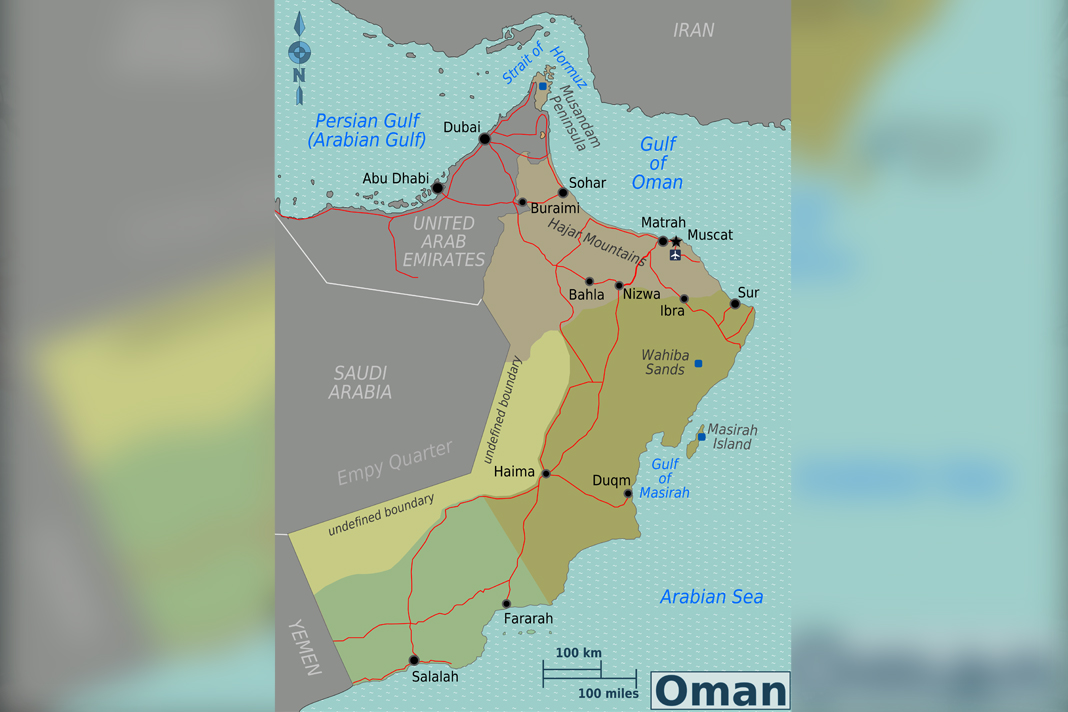
Feature image: Map of Oman | BurmeseDays/commons.wikimedia.org
DISCLAIMER
JOY! News is a Christian news portal that shares pre-published articles by writers around the world. Each article is sourced and linked to the origin, and each article is credited with the author’s name. Although we do publish many articles that have been written in-house by JOY! journalists, we do not exclusively create our own content. Any views or opinions presented on this website are solely those of the author and do not necessarily represent those of the company.