Written by: Afrika Mhlophe
I recently read a newspaper article suggesting that South Africa is getting close to becoming a failed state. This might sound alarmist to some people, but I can assure you that the signs are there. A failed state is one whose political or economic system has become so weak that the government is no longer in control. The more familiar term for this scenario is ‘state capture’ – which happens when the ruling elite and/or powerful businesspeople manipulate policy formulation and influence the game’s rules to their own advantage.
South Africa has Chapter 9 institutions supporting constitutional democracy. It also has an independent media and judiciary. Its constitution is hailed as one of the most progressive globally – with a Bill of Rights as its cornerstone. So how can it become a failed state? The fault line is with the country’s citizens’ lack of full participation in the workings of democracy. Part of the hindrance is the current electoral system. Proportional Representation (PR) – in which parties gain seats in proportion to the number of votes cast for them – hinders participative democracy.
In a recent judgement by the Constitutional Court, this system was found to be problematic in that it strips citizens of the right not to affiliate with a political party. The court ruled that individual candidates must be allowed to contest elections independently. The PR system is problematic, too, because it enables gatekeeping of the party list by politically connected people. The voters have no say on who goes on the list and where. Furthermore, it compromises the legislature’s independence to hold the executive to account because members of Parliament are beholden to the gatekeepers of the list and those who deploy the party cadres.
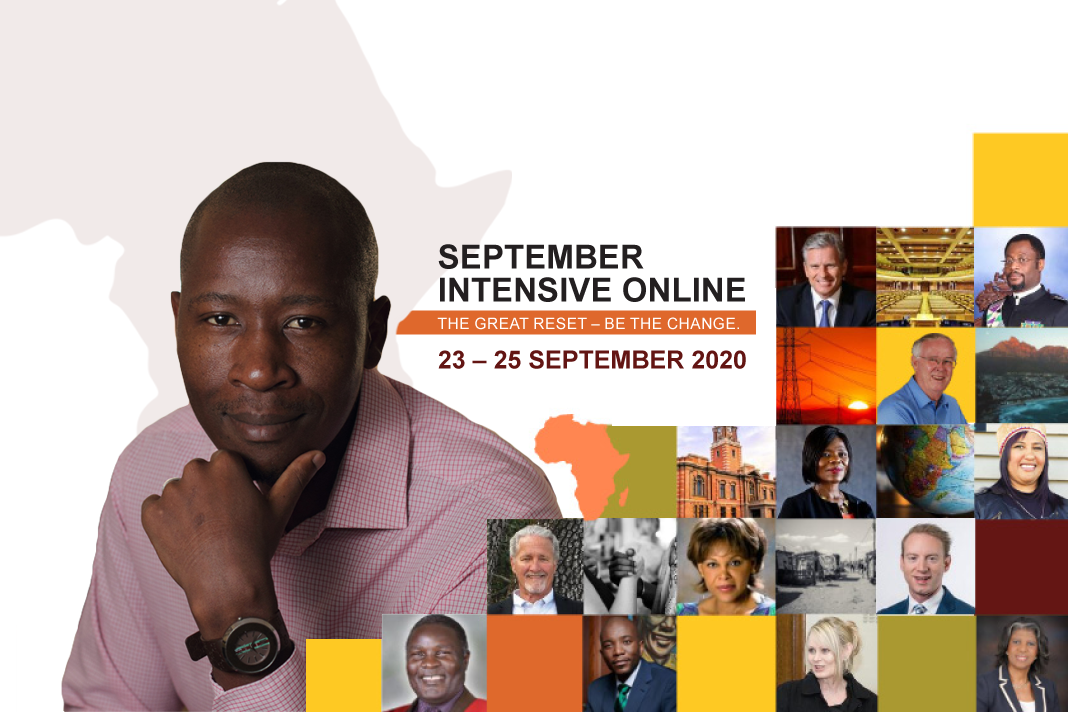
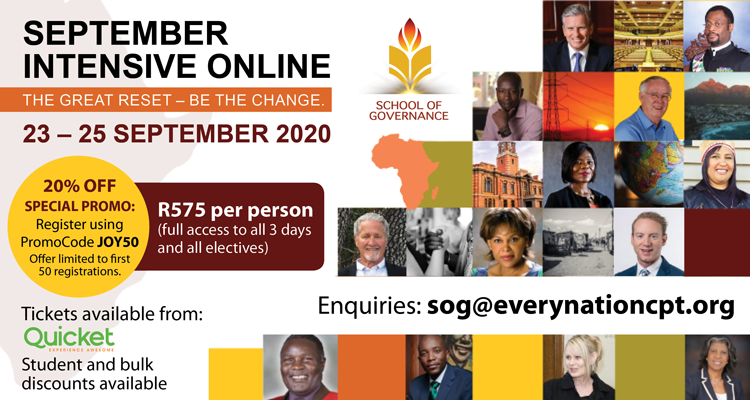
In the backdrop of this, the School of Governance South Africa is hosting its inaugural intensive with the overall theme: The Great Reset – Be the Change. The online conference will feature internationally acclaimed speakers, incl. Dennis Peacocke, Prof Thuli Madonsela, Afrika Mhlophe, Mark Beliles, Cheryllyn Verdon Dudley, HRM King Adamtey I (Ghana), Joshua Lwere, Michael Louis, Mmusi Maimane, Michael Cassidy, Dineo Molefe, Arno Van Niekerk, Lesiba Mothata, Linda Gobodo, Princess Chantal Revell, Wallace Mgoqi and some top change agents in economics and active citizenship.
The School of Governance believes that accountable, ethical, and responsible leaders who hate evil and fear God are key to the nations realising their true potential. As a South African, you need to know that we have now entered a time of adaptive change – the sort that occurs when people and organisations are forced to adjust to a radically altered environment. Our crime levels remain stubbornly high, and corruption does not decline – despite undertakings by successive governments. We need a different approach.
SPECIAL PROMOTION for JOY! readers: Save 20% when registering for this conference by using promotion code JOY50. Offer limited to first 50 registrations!
During World War I, Gerald Birney Smith urged America to lend its influence to end conditions that lead to war. In a 1917 paper titled, ‘Christianity and the Spirit of Democracy,’ he quotes President Wilson, who said that “the world must be made safe for democracy.” Smith then draws the church into the fray. He says, “if the world is to be made safe for democracy, there must be a religious interpretation of democracy.”
I have been a Christian for close to 25 years, and I don’t remember the Church wrestling with this issue. Yet the Bible shows us that the moral condition of those who lead directly impacts our ability to preach the gospel. This reminds me of Jeremiah’s letter to the exiled Jews. He encouraged them to seek the welfare of the city, rather than focus on personal wellbeing. And his logic was that “the more successful that nation is, the better off you will be.” – Jeremiah 29:7, CEV
Some Christians are aware of this reality and are busy praying “for those in authority.” But far too many approach the prayer with a reductionist mindset that ignores the obligation to choose wisely those who should occupy public office. But let us go to the question of religion and democracy. John A. Hutchison is convinced that the Bible has a lot to say on the subject of democracy.
In his paper, ‘The Biblical Foundations of Democracy,’ he shows that even when the Hebrew nation moved from a theocracy to a monarchy, no human was seen to be “invested with a divine significance.” In other words, the king was never deified, as was the case with pagan nations. As a monotheistic people, the Israelites believed that “to put one’s final allegiance in any human being … was the essence of idolatry.”
I believe Christians in South Africa are guilty of this very thing. Our allegiance to humans and the parties they lead has become an albatross and replacement of our faith in God. Smith gives us a lens through which we should see democracy. He says democracy means “human interests must be made supreme as contrasted with the interests of anyone class or group or nation at the expense of another.”
Does South Africa’s democracy meet this muster? It won’t if there is a lack of checks and balances. And this is where you come in. Our speakers in our upcoming conference will unpack principles that entrench democracy and foster accountability and good governance. Join us as we work together to prevent our nation from plummeting.

SPECIAL PROMOTION for JOY! readers: Save 20% when registering for this conference by using promotion code JOY50. Offer limited to first 50 registrations!
Tickets are available here from Quicket. The pricing is R575 per person for full access to all 3 days and all electives. Student and bulk discounts available. For all enquiries, email sog@everynationcpt.org or call 021 595 8900
Click here to KEEP UPDATED on the latest news by subscribing to our FREE weekly newsletter.
Date published: 17/09/2020
DISCLAIMER
JOY! News is a Christian news portal that shares pre-published articles by writers around the world. Each article is sourced and linked to the origin, and each article is credited with the author’s name. Although we do publish many articles that have been written in-house by JOY! journalists, we do not exclusively create our own content. Any views or opinions presented on this website are solely those of the author and do not necessarily represent those of the company.