Written by: INcontext International
Article source: www.incontextinternational.org
On Sunday 11 September, Sweden held its general elections. Swedish citizens voted to select the 349 members representing them in the Riksdag (parliament), who will in turn elect the prime minister. Voters also cast ballots to determine their representatives in municipalities and regional councils. This year’s election boasted a high voter turnout (around 81%), reflecting a keen interest among Swedish society in the way the country is run.
As of Tuesday 13 September, Sweden’s right-wing parties have taken the lead, with only votes abroad and advance votes left to be counted. It has been an extremely tight race between the left-wing bloc led by incumbent Prime Minister Magdalena Andersson (dominated by the Social Democratic Party) and the conservative bloc led by Ulf Kristersson – which includes his centre-right Moderate Party and the far-right Sweden Democrats Party (led by Jimmie Akesson). Ms Andersson – also a previous finance minister and current prime minister – is a well-respected leader who is seen as a reliable candidate to navigate the crises of high living costs and energy prices burdening households and businesses.
However, this year’s elections have also been dominated by traditionally right-wing local issues, such as concerns about gang violence (due to a rise in gang shootings), and immigration. The popularity of the Sweden Democrats (known to be anti-immigrant and nationalist) has peaked this year, outpolling the Moderate Party – the previously stronger right-wing party. While their share of votes has steadily increased over the past nine elections, this year they are positioned to have a direct influence over government policy.
Swedish parties seldom gain a majority in parliament, meaning that they generally need to form political alliances to set up a stable government. This is therefore one of the reasons smaller parties can play a decisive role in determining who ultimately wins government power.
From A Christian Perspective
 |  | ±10.5 MILLION |  | 55.87% CHRISTIAN 5.75% EVANGELICAL 21 UNREACHED GROUPS (3.9% of pop.) |
Some analysts have described this year’s election as one of the most important in Sweden’s history. One of the biggest talking points around this year’s election is the “resurgence of the right-wing”, following the trend seen in many other recent elections in other European countries such as France.
Many have found it surprising that Sweden has joined this shift since it is known for its liberalism and egalitarianism. For many Christians, neither of the most prominent options clearly reflect Christian values. However, there are pros and cons to the policies of both sides. For example, the conservative parties are less likely to oppose Christian schools, while the incumbent centre-left has a more welcoming immigration stance.
This reminds believers that our hope cannot be placed in political leaders. However, we can pray for God to guide their policymaking and help the Church respond to such policies in a way that will display Him to those affected by such policies. One of the benefits (or downsides) of coalitions is the potential for parties to moderate their policies to reach a mutual agreement within the group.
One way this could be beneficial if the right-wing bloc wins, is if the hard-line stance of the Sweden Democrats against immigration could be softened in line with the Moderates’ greater focus on effective integration of migrants (addressing some of the societal concerns that are seen as an outflow of ineffective integration).
Even better would be if their policies could be influenced by the Christian Democrats (with approximately 5.4% of seats) who also form part of the conservative coalition. The global Church can pray for this party, as well as believers in other parties in both blocs who are entrusted with political influence, to reflect Christ and have a godly influence in Sweden’s politics.
Please pray with us for the following:
- For those who are elected to have hearts that are open to godly wisdom and guidance so that they may lead Sweden righteously in this challenging season
- For Christian politicians to represent the character and values of Christ in their leadership positions
- For a spiritual revival among an increasingly secular Swedish society
Click here to KEEP UPDATED on the latest news by subscribing to our FREE weekly newsletter.
Date published: 26/09/2022
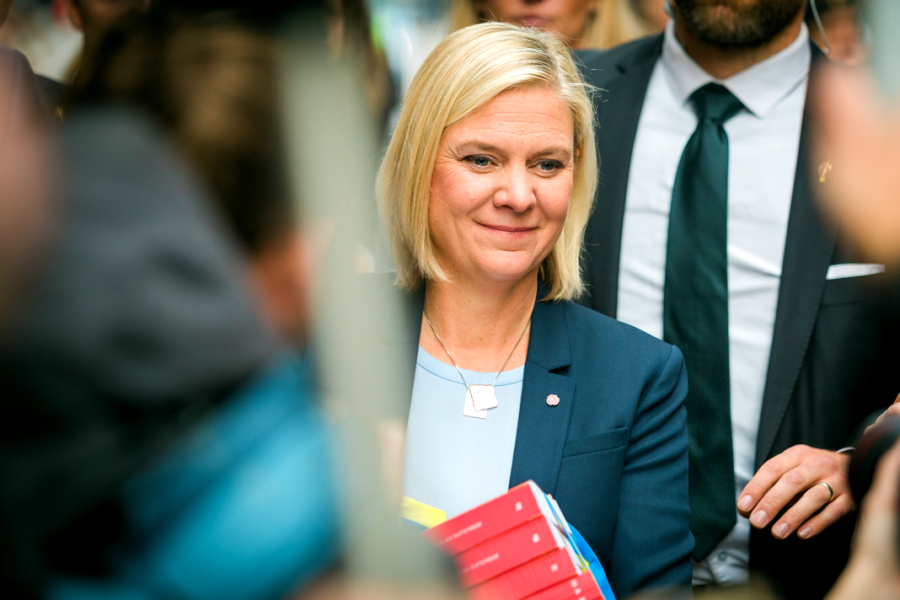
Feature image: Prime Minister Magdalena Andersson. Socialdemokraterna/www.flickr.com
DISCLAIMER
JOY! News is a Christian news portal that shares pre-published articles by writers around the world. Each article is sourced and linked to the origin, and each article is credited with the author’s name. Although we do publish many articles that have been written in-house by JOY! journalists, we do not exclusively create our own content. Any views or opinions presented on this website are solely those of the author and do not necessarily represent those of the company.