Interview by Gillian Fraser
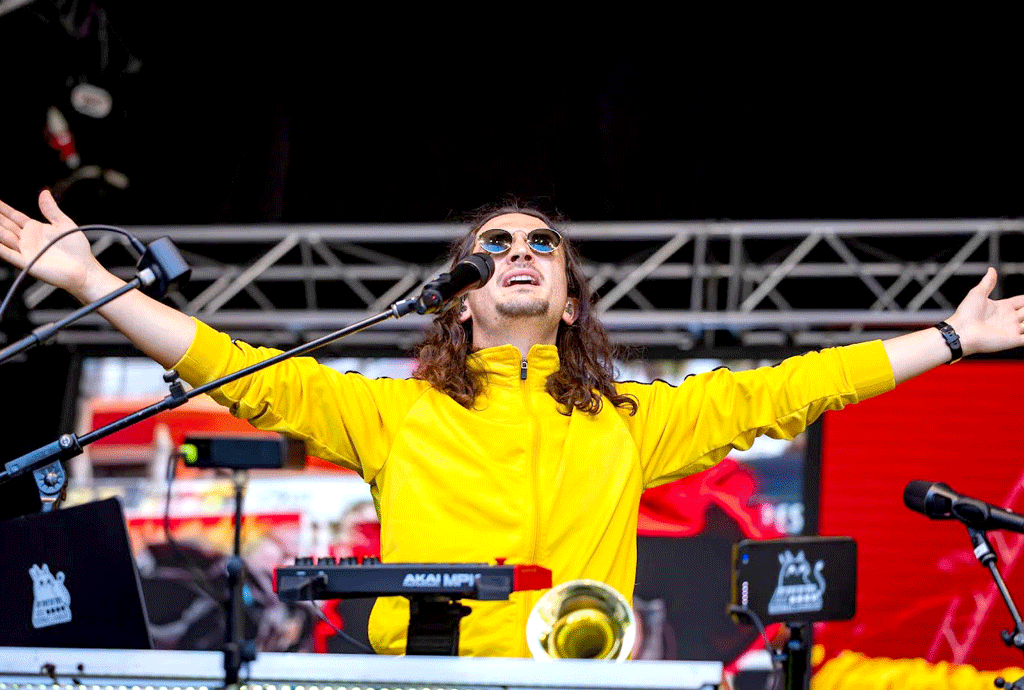
At the end of December, I went with my family to watch The Kiffness’ concert at Kirstenbosch Gardens. The crowd was packed, from babies and children to parents and grandparents. Hundreds, if not thousands, of placards could be seen throughout the crowd, all with cat faces on them. I looked at my mom and winked, knowing that she would think it all a little “strange”. But we were there to support David Scott, the man behind the “Kiff” persona; the man who had, one month prior, defended JOY! Magazine on social media when we were under attack for standing up for Biblical values. Following the incident, I reached out to Dave, wanting to hear more about his story. I was absolutely blown away by our conversation, and I hope you enjoy this interview.

Q. On social media you describe yourself as “Christian, husband, father, part-time musician”. Why did you choose that order? And why do you refer to yourself as a “part-time musician”?
I chose that order because Christ is the foundation which everything else is built upon. Christ informs how I am as a husband, and being a good husband allows me to be a good father. The “part-time musician” bit is a tongue-in-cheek stab at the fact that while music is my literal job, it’s not my primary calling. If the music disappeared tomorrow, I’d still have the three most important roles in my life intact. A career in music and the fame (or infamy) that comes with it is all fleeting, but relationship with God, my wife, and my boy is everything to me.
Q. Tell me about your faith. When did Jesus become real to you personally?
My journey really began in the crypt under my boarding school’s chapel on Friday nights. When I was 14, a friend invited me to “Christian fellowship”, and to be honest, he told me there would be free hot chocolate and marshmallows, so that was the initial draw! When we arrived, a couple of boys with guitars sang some Matt Redman, Chris Tomlin, and Hillsong songs. Up until then, I thought “church music” was strictly hymns and organs, so hearing these kinds of songs was quite refreshing. But the turning point wasn’t the music – it was when a 1st team rugby player stood up to share his testimony after the music. At most all-boys boarding schools, 1st team rugby players were idolised. But seeing a tough guy who I always thought had everything together being so vulnerable in front of a bunch of boys about his struggles and his need for God changed everything for me. It was the first time I saw what an authentic relationship with Jesus actually looked like. I kept going back, because I wanted to hear more from my fellow schoolmates who had experienced Jesus personally. Their testimonies inspired me to get to know Jesus too. I got given a daily devotional where the Bible suddenly became very real to me, and I began to understand what it all really meant – that we are all sinners deserving of death, yet Christ came to earth to die for our sins and has called us into relationship with Him. I eventually went on to start a Bible study on Tuesday evenings for anyone in my boarding house who was interested in learning more about God. This was the start of a lifelong journey of getting to know Jesus and growing in His Word.


Q. How does your relationship with Christ shape your life?
On my work:
For a long time, I was incredibly goal-oriented. I lived in a cycle of “if only” – if only I had this many followers, or if only I could play this specific show, then I would have “made it”. But as I began to tick those boxes, I realised those milestones were fleeting. They offered a short-term hit of satisfaction that evaporated almost immediately. Over time, I discovered that the thing I was chasing all along was already right in front of me: the creative process itself. Being able to sit in my studio and create something from nothing has always been the real prize. Anything that comes as a result of that work is either a bonus or a distraction. I’ve realised that metrics are the ultimate distraction. It is so easy to get sucked into the “algorithm trap”, where you feel you have to outperform your last video just to feel successful. When a project didn’t perform well, it used to affect me deeply. But I’ve reached a place where I truly don’t care about the numbers anymore. My focus has shifted to what I learnt during the journey. If I enjoyed the process and stayed true to the inspiration, that is success, even if the song never goes viral.
On my public voice:
In the age of cancel culture and intense social pressure, it’s tempting to just say what will make people like you. But my faith gives me a different compass. My music has granted me favour with the world which I believe is a wonderful gift, but it shouldn’t be a leash. I’ve had to put my convictions to the test in very practical ways recently. I lost a major brand deal for speaking out about the murder of Charlie Kirk, and I was even disinvited as a guest speaker at my own junior school because of my criticisms of the Gift of the Givers founder, Dr Imtiaz Sooliman. On top of that, I’ve been lambasted by the government, the media, and various NGOs for my stance on the October 7th Hamas attacks and my opposition to Julius Malema’s “Kill the Boer” chants.
In the past, being treated as a pariah by my old school or the national media might have devastated me. But throughout it all, I’ve felt a total sense of peace. Being able to lose a significant opportunity and not feel shaken is a testament to the work God has done in my life. It confirmed that my security isn’t in my bank account or my reputation, but in knowing I stayed true to what I felt was right before God. When it gets tough, I remind myself of Mark 8:36, “For what does it profit a man to gain the whole world and forfeit his soul?”
On my family life:
Christ’s example of sacrificial love is the blueprint for how I treat my wife and raise my son. It’s easy to be “The Kiffness” to the public, but the real test of my faith is who I am when the cameras are off. Being a Christian means I recognise that my family is my primary ministry. I want my son to grow up seeing a father who is the same person in the lounge as he is on the stage. My relationship with Jesus keeps me grounded, reminding me that no matter how big the world gets, the most important work I’ll ever do is within the four walls of my home. My wife and I have just celebrated our 10-year wedding anniversary. What an incredible journey it has been. My wife is a beautiful person, a wonderful partner and the best mom I could ever think of to our boy. I don’t know what I did to deserve her, but I honestly am so thankful for everything she does for our family.
Q. You’ve become increasingly outspoken online. What prompted you to start speaking more openly about cultural and political issues?
For a long time, I was content just being “the funny music guy”. But as my platform grew, I began to feel a sense of responsibility. I realised that having a massive audience isn’t just about entertainment, but rather a form of stewardship. During my second year at Rhodes University, a prophetess named Val McLeland visited our church. I deliberately sat at the back of the hall that day because I didn’t want to be called up and “exposed” in front of the whole church (I was still a young and immature Christian at the time), but she called me up and told me that God was going to give me great favour with the world, but that a moment would come when I would have to choose between that world or Jesus. She warned me that choosing Jesus would bring heavy persecution, but that I would find peace in knowing it was the right choice. Back then, the words were quite overwhelming and didn’t make much sense, but as my platform grew and “The Kiffness” began to gain global popularity, I kept recalling that prophecy in my mind, and it slowly started to make more sense. I realised that if God has truly given me “favour with the world”, I have to be a faithful steward of that influence. I began to understand that silence in the face of injustice is often just a polite form of complicity. I decided that if losing a major brand deal or facing a social media persecution is the price for speaking the truth, then it’s a price I’m willing to pay. My faith gives me the spine to stand firm because I know my ultimate approval doesn’t come from a Twitter mob or a corporate board, but from God. I’ve found a strange paradox in this journey – when you finally stop trying to please everyone, you actually start reaching the people who need to hear the truth the most.

Q. Do you believe Christians have a responsibility to speak up in the public square?
I don’t believe there is a one-size-fits-all “mandate” for every Christian to be a public commentator. In fact, it’s a mistake to suggest that everyone is called to speak up in the public square. I believe everyone has their own unique path they need to be obedient to. For some, their calling is to be a light in the spotlight, speaking truth to power and navigating the persecution that comes with it. For others, their calling is to be a light in their local community, their workplace, or their home, serving in ways that no one will ever see on a social media feed. For some, there are seasons for being in the spotlight, and there are seasons for being quiet. I speak here for myself, because I’ve recently taken a step back from the public square – I’ve basically nuked my whole X account and am spending this year focusing on God, my family, and my music. I found the public square was becoming more of a distraction than something that was serving God. I found myself worrying about far away conflicts when I needed to be a present father, or scrolling in my studio when I should’ve been making music. Everything that truly mattered to me began to suffer as a result of the all-consuming noise online, especially on X, and I found myself in a constant state of subconscious anxiety. This year I already feel a lot happier because I’ve been able to tune out that noise and tune more into the signal – being a good husband, father, and musician. With that being said, speaking up about certain issues felt right at the time and I don’t regret anything I’ve ever said in the past. There will likely be a time in the future where I feel called to be back in the public square, but for now I feel God has called me to step back and to focus on the things in my immediate sphere of influence. There is a season for everything.
Q. You’ve said in the past that truth matters more than popularity or reputation. Where does that conviction come from?
There’s a saying, “You can be the juiciest, most delicious peach in the world and there will still be people who don’t like peaches.” For a long time, I think I was trying to be a “peach” that everyone liked. But as my faith matured, I realised that if I spent my life trying to change myself to suit people’s tastes, I’d eventually lose the very thing God created me to be. I knew that when I decided to start being more authentic, that pushback was par for the course. But it’s incredibly freeing when you realise your reputation isn’t yours to manage, but God’s. If I am being the “peach” God created me to be, and people still don’t like it, that’s not my burden to carry. My job is to be obedient, and His job is to manage whatever the consequence of that might be.
Q. Why do you think humour is such a powerful way of commenting on culture?
I’ve always said that if the truth is broccoli, then humour and satire are the cheese sauce. Broccoli is incredibly good for you, but it can be a bit tough to get down on its own. I speak from experience as a father of a 4-year-old. Humour (the cheese sauce) makes the truth more digestible and easier to swallow. It disarms people. When someone is laughing, their defences are down, and that’s often the only time a difficult or challenging truth can actually get through. I also believe we see this modelled in the Bible. If you look at the parables of Jesus, it’s clear that many were told with a decent amount of humour. Take the parable of the man trying to pick a speck out of his brother’s eye while he has a literal log sticking out of his own. That is comedy gold, and it makes me think Jesus would have been a great stand-up comedian. Jesus used that kind of “cartoonish” imagery because it sticks (excuse the pun). It makes a heavy topic like hypocrisy much easier to deal with and much harder to forget. Satire isn’t about being mean-spirited; it’s about using a mirror to show the world its own absurdities. In a culture that is often so heavy and polarised, humour can be a powerful way to point people back to common sense and, ultimately, to the Truth.
Q. What role should Christians play in shaping the future of our nation?
I believe the most powerful role a Christian can play is simply to be obedient to the specific calling God has placed on their life. We often look for national solutions in high places, but true change usually starts with individual surrender. When you listen to what God is calling you to do and you remain obedient to that, you don’t just see a transformation in your own life, you naturally become a blessing to everyone around you. Whether God is calling you into politics, the arts, or the quiet service of your own home, the goal is the same: to live in a way that honours Him. My prayer for our nation is that Christians would rise up in every field, not to seek power for themselves, but to lead with integrity, to act in line with what God has commanded, and to keep Him at the forefront of every decision. If we have a generation of believers who are more concerned with God’s will rather than with worldly success, that is when we will see the future of South Africa truly begin to shift.

This article appears in the May 2026 edition of JOY! Magazine. Read the digital version of this magazine here: joygifts.co.za
Click here to KEEP UPDATED on the latest news by subscribing to our FREE weekly newsletter.
> Please support Christian media and journalism in South Africa. Help us to spread the Word of God and take a stand for the truth by making a donation to our ministry. We appreciate your support. Click here to take hands with JOY! Magazine.
Date published: 13/05/2026
Feature imageS: JOY! Magazine published article
DISCLAIMER
JOY! News is a Christian news portal that shares pre-published articles by writers around the world. Each article is sourced and linked to the origin, and each article is credited with the author’s name. Although we do publish many articles that have been written in-house by JOY! journalists, we do not exclusively create our own content. Any views or opinions presented on this website are solely those of the author and do not necessarily represent those of the company.