Article source: harbingersdaily.com
Chinese leader Xi Jinping is telling the military to focus on strengthening combat readiness over the next five years as he warns of uncertainties domestically and abroad.
Ensuring the Chinese armed forces are prepared for war should be the leading objective in the country’s military building, Xi, who heads the Central Military Commission, said on March 9 in an address to delegates of the Chinese armed forces during Beijing’s annual legislative sessions.
“The current security circumstances of our country are largely unstable and uncertain,” he said. He instructed the armed forces to “heighten their sense of urgency” and “hurry up” to accomplish the annual military objectives as outlined in the 14th Five Year Plan, the country’s latest policy roadmap.
Unveiled in Beijing on March 5, the proposal calls for the cooperation between military and civilians, or what it termed “civil-military fusion,” to equip the military with artificial intelligence-powered weapons and other cutting-edge technologies.
“The Chinese military as a whole must make ready to meet with various complex and difficult circumstances, and resolutely defend national sovereignty, safety, and development interests,” Xi said.
Xi’s order built upon his January command, in which he called on the regime’s military to “focus on preparing for war, deepen the transformation of military training, build a new type of military training system, and comprehensively improve the level of combat training and ability to win.”
Years of continual spending growth have made Chinathe world’s second-largest military spender after the United States. In the 2020 report [pdf], the U.S. Department of Defense described both the Chinese army and navy forces as the largest in the world, noting that the Chinese military, known as the People’s Liberation Army, “is developing capabilities to provide options for the PRC [People’s Republic of China] to dissuade, deter, or, if ordered, defeat third-party intervention during a large-scale, theater campaign.”
Over the coming year, Beijing plans to spend more than 1.38 trillion yuan ($212 billion), an increase of about 6.8 percent from 2020, according to Wu Qian, the spokesperson for China’s Ministry of National Defense.
In an interview with Chinese media on Sunday, Wu justified the hike in military expenditure as necessary for both “self-defense and protecting world peace,” saying it was “beyond reproach.”
China faces homeland security challenges that “cannot be overlooked,” Wu said, including “rising hegemonism, power politics, unilateralism”—wording that Beijing frequently invokes when referring to the United States—among threats he said would undermine China.
“The world is far from peaceful, therefore our national defense must scale up,” he said.
While the Chinese regime has denied its seeking to pursue hegemony, it has grown more aggressive in the Taiwan Strait and the South China Sea.
Beijing is currently holding a month-long military exercise through March 31 in a zone with a radius of roughly 3.1 miles in the South China Sea, vowing that they “will not lose an inch of the land that our ancestors left to us.”
Chinese warplanes have intruded into the air defense identification zone of Taiwan, a self-ruling island that the regime claims as part of its territory, on a near-daily basis since the start of this year. Last week, it abruptly banned the import of Taiwanese pineapple on accounts of pests. More than 90 percent of Taiwan’s pineapple exports went to China last year.
Wu, the national defense spokesperson, warned Taiwan in late January that “independence means war.”
He reiterated the same position in the March 7 interview, saying that the Chinese Communist Party “reserves the option to deploy all necessary measures” to bring Taiwan under its fold, including using military force.
Chinese diplomats have repeatedly called the regime’s claim to Taiwan a “red line” issue that cannot be crossed. Foreign Minister Wang Yi on March 7 told the Biden administration to undo former President Donald Trump’s “dangerous practice” of supporting Taiwan, an action he said was “playing with fire.”
Adm. Philip Davidson, head of U.S. Indo-Pacific Command, expressed fears that the Chinese military may be making “vast advances” in both its size and capabilities to supplant the United States on the world stage.
He described the Indo-Pacific region as the “most consequential region for America’s future,” where the United States’s deterrence posture “must demonstrate the capability, the capacity, and the will to convince Beijing unequivocally the costs of achieving their objectives by the use of military force are simply too high.”
“They’ve long said they want to be that by 2050. I’m worried about them moving that target closer,” he said.
Click here to KEEP UPDATED on the latest news by subscribing to our FREE weekly newsletter.
Date published: 18/03/2021
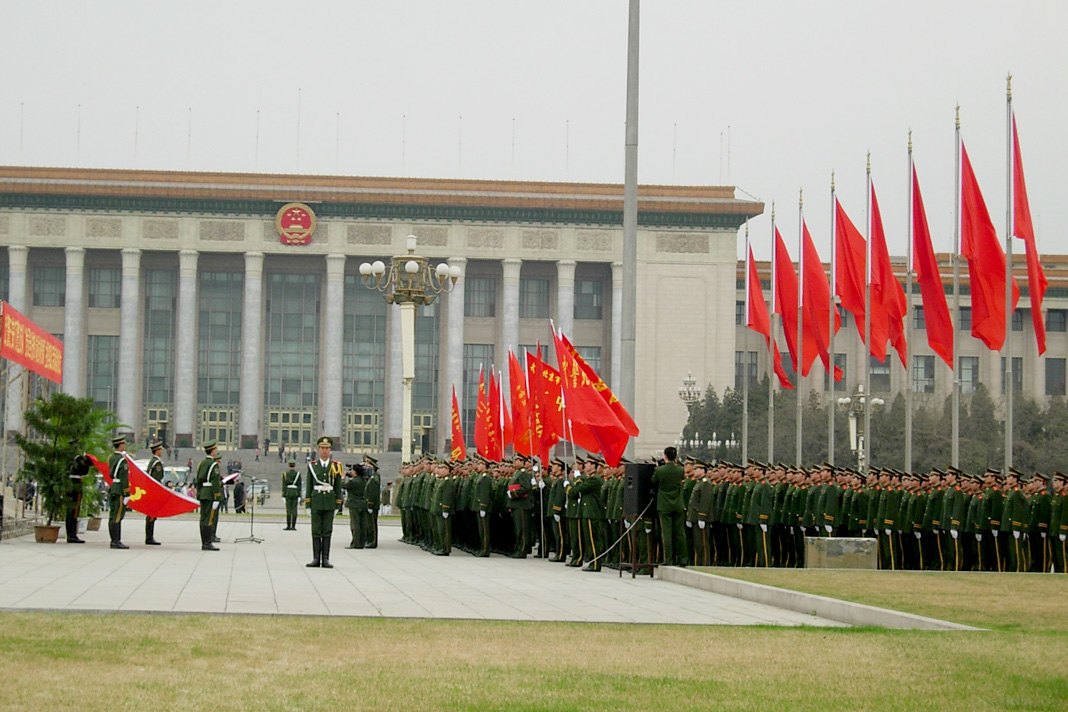
Feature image: Image for illustrative purposes only. The Army in Tienamen Square. www.flickr.com/Elyse
DISCLAIMER
JOY! News is a Christian news portal that shares pre-published articles by writers around the world. Each article is sourced and linked to the origin, and each article is credited with the author’s name. Although we do publish many articles that have been written in-house by JOY! journalists, we do not exclusively create our own content. Any views or opinions presented on this website are solely those of the author and do not necessarily represent those of the company.