


Written by: James Lasher
Article source: mycharisma.com
A controversial new reading of ancient Egyptian inscriptions may lend support to the biblical story of the Exodus.
As reported by the Daily Mail, researcher Michael Bar-Ron said a 3,800-year-old Proto-Sinaitic inscription, etched into the rock at Serabit el-Khadim in Egypt’s Sinai Peninsula, could read “zot m’Moshe,” Hebrew for “This is from Moses.” The carving, located near Sinai 357 in Mine L, is part of more than two dozen Proto-Sinaitic texts discovered in the early 1900s.
Bar-Ron, who spent eight years studying high-resolution images and 3D scans, told Patterns of Evidence, “We find worshipful inscriptions lauding the idol Ba’alat, with clearly an El or God-serving scribe coming in later and canceling out certain letters, in an effort to turn the message into a God-serving one. This is ground zero for this conflict.”
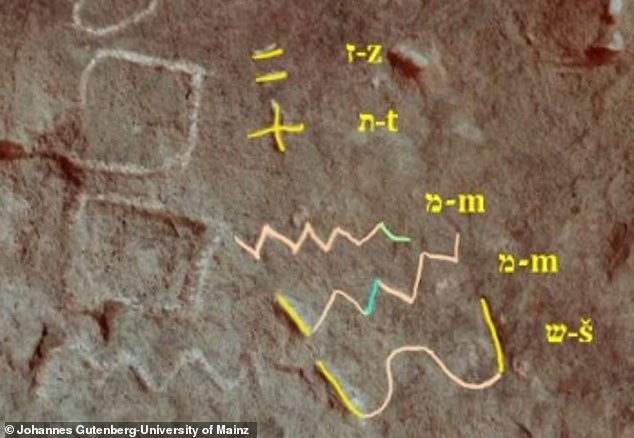
A controversial Proto-Sinaitic inscription from Serabit el-Khadim, believed by some to reference Moses | Photo: Michael S Bar-Ron – Johannes Gutenberg University
The researcher suggested the phrase could indicate authorship or dedication connected to a figure named Moses. He added, “I took a very critical view towards finding the name ‘Moses’ or anything that could sound sensationalist. In fact, the only way to do serious work is to try not to find elements that seem ‘Biblical,’ but to struggle to find alternative solutions that are at least as likely.”
Other nearby inscriptions reference El, a deity associated with early Israelite worship, and show evidence that the name of the Egyptian goddess Hathor was defaced. Some carvings also mention slavery, overseers and a rejection of the Baʿalat cult, which Bar-Ron said may point to “a violent purge and the workers’ eventual departure from the site.”
Bar-Ron’s advisor, Dr. Pieter van der Veen, supported the interpretation, saying, “You’re absolutely correct, I read this as well, it is not imagined!”
But other scholars urged caution. Dr. Thomas Schneider, professor of Egyptology at the University of British Columbia, said the claims are “completely unproven and misleading,” warning that “arbitrary identifications of letters can distort ancient history.”
The findings have not been published in a peer-reviewed journal, leaving the debate over whether the name of Moses is preserved in the world’s earliest alphabet unresolved.
Click here to KEEP UPDATED on the latest news by subscribing to our FREE weekly newsletter.
> Please support Christian media and journalism in South Africa. Help us to spread the Word of God and take a stand for the truth by making a donation to our ministry. We appreciate your support. Click here to take hands with JOY! Magazine.
Date published: 14/08/2025
Feature image: Ancient Serabit el-Khadim mining site in Egypt’s Sinai Peninsula, where the Proto-Sinaitic inscriptions were uncovered. | Photo: Roland Unger
DISCLAIMER
JOY! News is a Christian news portal that shares pre-published articles by writers around the world. Each article is sourced and linked to the origin, and each article is credited with the author’s name. Although we do publish many articles that have been written in-house by JOY! journalists, we do not exclusively create our own content. Any views or opinions presented on this website are solely those of the author and do not necessarily represent those of the company.





Sent from a friend from Egypt after reading this article …
“ Interesting!
However, Moses of the Bible may have lived less than 3500 yrs ago … (not 3800)
plus the name Moses was Egyptian
indeed as the adoptive mother is the one who named him. So I think it was a popular name.
So chances are it is not the biblical Moses but this discovery may lead to more discoveries.
Thanks for sharing. “