Written by: Michael Swain, FOR SA Executive Director
Article source: JOY! Magazine
Have you ever woken up one morning to realise that a new law, policy, or regulation that you neither wanted nor like is now in force and enforceable? This may leave you with a sense of helplessness. However, the good news is that South Africa is a constitutional democracy and our Constitution is supreme, not our Parliament or any other organ of the state. The Constitution grants important rights that attach to you, as an individual, and can only be limited in compliance with the test set out in detail in section 36 of the Constitution.
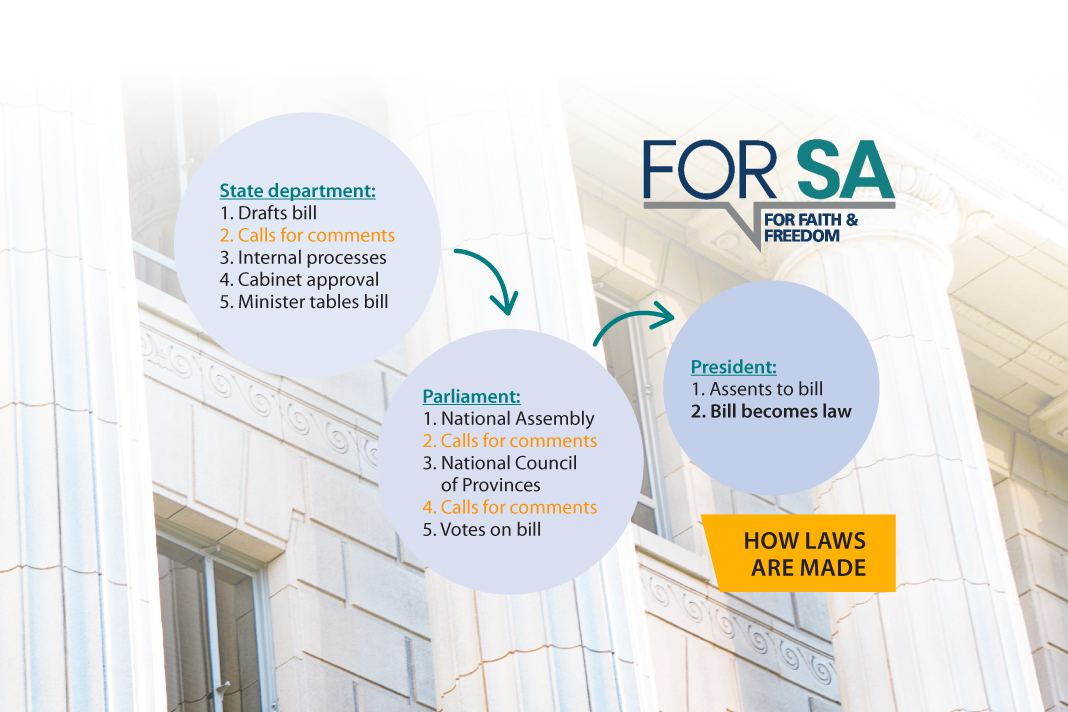
How laws are passed
Our national system of government is divided into three branches, the legislative, the executive and the judiciary. The legislative authority includes our Parliament, which consists of two houses, the National Assembly and the National Council of Provinces (NCOP). The laws that these bodies consider are typically drafted initially in various governmental departments and each stage is subject to a public consultation and participation process before it can be assented to by the president (the executive) and passed into law.
Public participation is critical
South Africa’s constitutional democracy is representative and participatory in nature. This participation is not simply confined to how we cast our vote during a national election. Section 59 of the Constitution requires the National Assembly to facilitate public involvement throughout the law-making process in an open manner. Section 72 places the same requirements on the NCOP. However, we need to exercise our rights in order to enjoy any benefit from them. That is why public (or civic) engagement in the law-making process is critical in a functioning democracy. That is why FOR SA goes to great lengths to scrutinise every bill, draft policy, and regulation to see if it has the potential to erode our right to religious freedom (guaranteed by section 15 of the Constitution). We then formulate a response and a position to protect and uphold this right, which we then communicate widely to our constituency and the media.
We need your involvement
As citizens and stakeholders, we need to actively engage and become directly involved in the law-making process, because the more we raise our voices in unison, the more attention government must pay to our position. If government then ignores or fails to be properly directed by this public participation process, it is immediately possible to apply to court (the judicial branch) and to challenge the entire process. Our judiciary has made it clear in multiple judgements that whenever government fails to follow proper process, including engaging in meaningful public participation, the resulting law is tainted and can be overturned. By contrast, when legislation is passed legitimately after proper public participation, people will be more accepting of whatever law may thereafter be passed.
Sign up today!
Make sure you sign up for the FOR SA newsletter and alerts to receive accurate, timely information so that you never miss another opportunity to have your say in our law making process!

Click here to KEEP UPDATED on the latest news by subscribing to our FREE weekly newsletter.
Date published: 15/02/2023
DISCLAIMER
JOY! News is a Christian news portal that shares pre-published articles by writers around the world. Each article is sourced and linked to the origin, and each article is credited with the author’s name. Although we do publish many articles that have been written in-house by JOY! journalists, we do not exclusively create our own content. Any views or opinions presented on this website are solely those of the author and do not necessarily represent those of the company.