Written by Philippe de Beer; Parklane Properties
Article originally featured in the September issue of JOY! Magazine
On Bitcoin, bricks, diversification, and the kind of wisdom that protects families
Over more than two decades working in property markets, I have watched investment trends come and go. The names change – leveraged equity funds, structured credit products, crypto currencies, NFTs, AI-driven trading platforms. The pattern rarely does: rapid ascent, intense media attention, public excitement, and for many who arrive after the early gains, significant loss. Paul’s words to Timothy (1 Tim 6:17) have never felt more relevant. Wealth is uncertain. The question for a family trying to build something lasting is which asset will still be standing in ten years – still generating income, still preserving capital, still within reach when you need it.
When speed meets reality
Bitcoin reached nearly $69 000 in November 2021. By November 2022, it had fallen to $15 700 – losing over 77% of its value in 12 months. It recovered, climbed to a new all-time high of
$126 000 in October 2025, and has since pulled back to around $65 000 – a decline of more than 48% from that peak in nine months. That trajectory tells the story more clearly than any analysis could. Those who understand this market deeply – who entered early and managed their exposure with discipline and genuine expertise – have done well. Crypto rewards knowledge, timing, and nerve. But it remains, by its very nature, one of the most volatile asset classes ever created. Wide price swings are not exceptions. They are the pattern.
Penalties for investing in South Africa
The regulatory landscape is also shifting significantly for South African investors. From March 2026, SARS enforces the Crypto-Asset Reporting Framework – a global standard giving tax authorities automatic visibility into every crypto transaction and wallet transfer. All exchanges now report directly to SARS, with automatic reconciliation against personal tax returns. Non-compliance carries penalties of up to R1 million or the full value of the asset held. The era of crypto as an informally managed store of value is, for South African investors, effectively over. Taken together – extreme price volatility, specialist expertise required, and a tightening regulatory environment – crypto presents a profile that is genuinely difficult to manage over the long term for the average investor.
The wisdom of spreading
Genuine wisdom means spreading capital across asset classes that behave differently under different conditions. For the portion you want liquid – accessible within hours – professionally managed funds remain a sound option. The brief to your asset manager matters enormously: be clear on capital preservation, liquidity, and the returns you expect above fixed deposit rates. Equally important is your currency intention – whether you want to remain invested in rand within South Africa, or move a portion into hard currencies offshore, where your capital is sheltered from rand depreciation and local inflation. Both have a role in a well-structured portfolio, and the balance between them depends on your personal situation, timeline, and what you sense this season requires. Across every market cycle however, one asset class has consistently formed the most reliable anchor of all.
Why property remains the foundation
Bricks and mortar: in the right place, at the right price, in the right structure. Property performs year after year with grounded, straightforward management – generating income, building equity, preserving capital. A well-placed investment property generates monthly rental income, appreciates over time, and can be sold through a known, predictable process when liquidity is genuinely needed. Many astute investors have chosen to concentrate the majority of their long-term wealth in property alone – but spread intelligently across different types: residential for consistent rental income, short-term holiday rentals in high-tourism destinations for premium yields, and commercial or office property for longer lease terms and a different risk profile. Each behaves differently under different conditions, providing real diversification within a single, tangible asset class. The same principles that govern every sound investment apply: genuine demand locations, rational prices, manageable debt, and a legal and tax framework that works in your favour.
Why Mauritius is attracting serious attention
For over 20 years, Mauritius has offered foreign investors access to its property market through a series of dedicated schemes – each designed to serve different buyer profiles, and each structured separately from the local Mauritian market to protect property values for Mauritian citizens. That separation has held. And within these schemes, property values have shown consistent, measurable appreciation across two decades.
A tax haven for investors
The framework that attracts discerning investors is straightforward: zero capital gains tax, no inheritance tax, no wealth tax, a recognised low-tax jurisdiction for those considering fiscal expatriation, no wealth tax, and no property taxes – no rates or municipal charges of the kind South African families are accustomed to paying. An active Double Taxation Avoidance Agreement with South Africa ensures income earned in Mauritius is not taxed twice. And for qualifying property investments above $375 000, permanent residency is gained – valid for the duration of property ownership, family included. In well-managed properties, supported by the island’s strong and consistently resilient tourism industry, rental yields of 4 to 6 % net annually in hard currency are achievable. That income continues regardless of what the rand does.
Wisdom for this season
Diversify across asset classes. For those who intend to remain in South Africa and earn in rand, reputable local wealth managers offer a range of investment products that can deliver solid returns above inflation and fixed deposit rates – all without the complexity of offshore structures. For those looking beyond local borders, keeping a portion genuinely liquid in hard currency under professional management adds a meaningful layer of protection against rand depreciation and local economic pressure. Both approaches are valid – what matters is that the choice is made deliberately, with clear eyes and proper counsel. Plan for investments that generate monthly income – whether through rental returns, interest distributions, or dividend streams – that can fund a meaningful portion of your daily living expenses. That shift, from simply saving to actively generating income, is where real financial freedom begins. And anchor your portfolio in real property in a stable, well-regulated market. These are straightforward principles – consistent with the kind of grounded, clear-eyed wisdom that this particular season demands

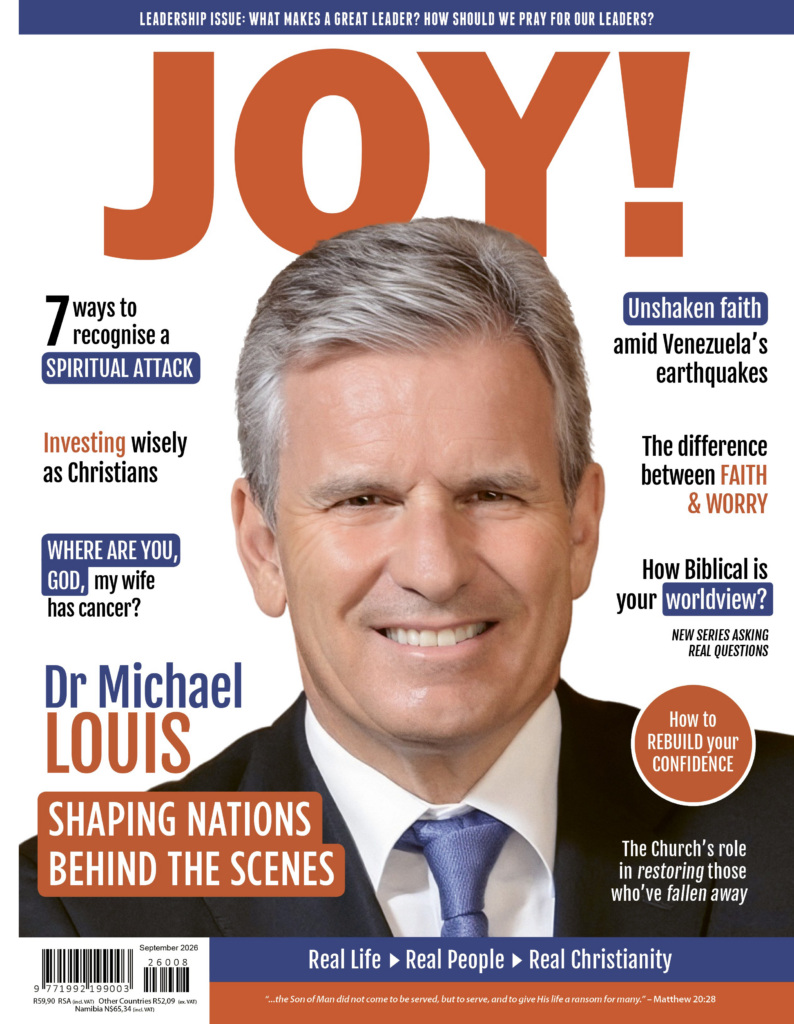
This article appears in the September 2026 issue of JOY! Magazine. Read the digital version of this magazine here: joygifts.co.za
Click here to KEEP UPDATED on the latest news by subscribing to our FREE weekly newsletter.
> Please support Christian media and journalism in South Africa. Help us to spread the Word of God and take a stand for the truth by making a donation to our ministry. We appreciate your support. Click here to take hands with JOY! Magazine.
Date published: 31/08/2026
Feature image: Sourced from original article published in the September issue of JOY! Magazine
DISCLAIMER
JOY! News is a Christian news portal that shares pre-published articles by writers around the world. Each article is sourced and linked to the origin, and each article is credited with the author’s name. Although we do publish many articles that have been written in-house by JOY! journalists, we do not exclusively create our own content. Any views or opinions presented on this website are solely those of the author and do not necessarily represent those of the company.